
Perspectives on the Science
Neoadjuvant ICI for Resectable CSCC
2022
Squamous Cell Carcinoma
Neoadjuvant
In this Perspectives on the Science piece, we reflect on the impact of the recently published article Neoadjuvant Cemiplimab for Stage II to IV Cutaneous Squamous-Cell Carcinoma.
Keywords
Squamous Cell Carcinoma, Neoadjuvant, Cemiplimab
Article status

Featured Article
Gross ND et al. Neoadjuvant Cemiplimab for Stage II to IV Cutaneous Squamous-Cell Carcinoma. New England Journal of Medicine. 2022;387(17):1557–1568. PMID: 36094839. (Gross et al. 2022)
Introduction
On October 7th, 2022, the multi-institutional Community of Cutaneous Oncology Journal Club reviewed the recently published New England Journal of Medicine article, “Neoadjuvant Cemiplimab for Stage II to IV Cutaneous Squamous-Cell Carcinoma” (Gross et al. 2022).
Participants included clinicians and investigators from Massachusetts General Hospital, Mass Eye and Ear Infirmary, Brigham and Women’s Hospital (BWH), George Washington Cancer Center, the National Institute of Health, University of Pennsylvania, and Moffitt Cancer Center.
The comments in this Perspectives on the Science article represent the views of the authors following the Journal Club discussion; they do not represent the views of other members of the Interest Group or the affiliated institutions. Here, we summarize the discussion surrounding this important contribution to the literature. Several Journal Club participants were investigators on the study and authors of the NEJM article.
Background for the Study
Although the vast majority of cutaneous squamous cell carcinomas (CSCC) are treated and cured with local destruction or surgical excision, a subset of patients experience poor outcomes, including regional nodal and distant metastases. Approximately 6% of patients with CSCC will go on to develop nodal or distant disease, resulting in a mortality of 1.5–2% (Patel et al. 2021; Thompson et al. 2016). Consequently, there is an unmet need to identify alternative treatment strategies that improve outcomes for patients with high-risk CSCC.
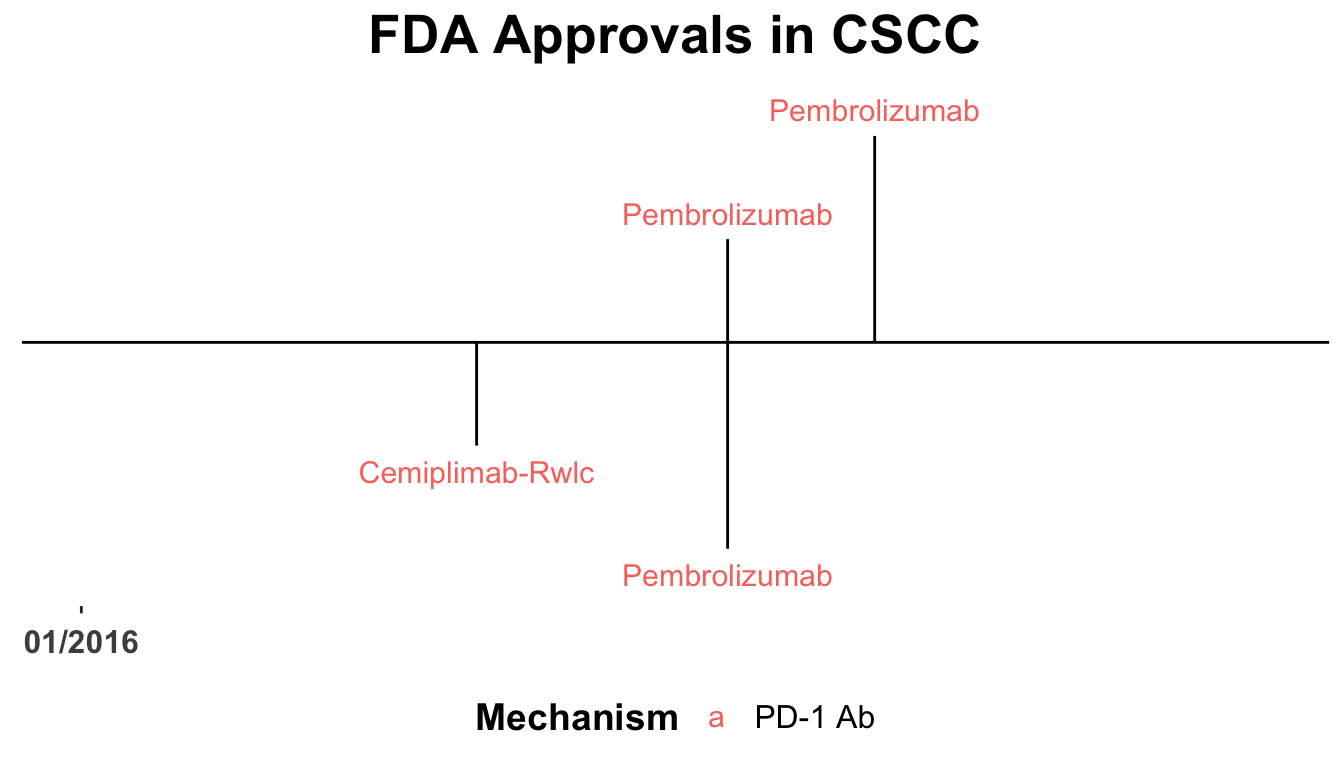
The therapeutic landscape for CSCC has rapidly evolved over the last five years (Shalhout et al. 2021, 2023; Miller et al. 2022) (Figure 1). More recently, clinical trial data have led to the approval of immune checkpoint inhibitors for locally advanced and metastatic CSCC (Migden et al. 2018; Grob et al. 2020).
Objective response rates for advanced disease ranging from 46–51% and 35–50% in EMPOWER-CSCC-1 and KEYNOTE-629, respectively, led to the hypothesis tested by Gross et al. that pre-operative anti-PD-1 therapy would improve pathological response rates at the time of surgical excision.
Study Design
The investigators conducted a company-sponsored, phase 2, multicenter, non-randomized study involving 79 patients with high-risk disease. Patients were eligible if they had resectable Stage II or greater disease. Of note, only Stage II patients with primary lesions >3 cm were eligible. Participants received up to four doses of cemiplimab 350 mg every three weeks, followed by surgical resection. The primary endpoint was the pathological complete response (pCR) rate. The null hypothesis was a pCR rate of 25%. Following surgery, investigators were allowed to select a postoperative course that included observation, adjuvant radiotherapy, or continued cemiplimab.
Main Findings
Pathological complete responses were seen in 40 patients (51%), with another 10 patients exhibiting a major pathological response, defined as <10% viable tumor cells in the surgical specimen. Adverse events (AEs) were seen in 87% of patients, with grade 3 or greater AEs occurring in 18%. Four patients died during the study.
Discussion Points
The consensus among the Interest Group was that this study was practice-changing. A few participants were already incorporating pre-operative immune checkpoint inhibitor (ICI) therapy for some of their highest-risk patients before publication of these results. Other participants who were primarily using ICI therapy according to FDA indications, such as locally advanced or metastatic disease, stated that they would consider implementing ICI earlier in the disease journey as a result of this study.
Participants, however, stressed the importance of assessing the benefit-to-risk ratio. The absolute risk of poor outcomes across the stages represented in this population varies and, in many cases, remains incompletely clarified. This may be related in part to CSCC not being included in the Surveillance, Epidemiology, and End Results Program. Consequently, prognostic estimates of local recurrence, nodal and distant metastases, and disease-specific death have come largely from single-institution datasets and remain limited.
For example, a 2019 study by Ruiz et al. evaluated the prognosis of 459 patients at BWH (Ruiz et al. 2019). The 10-year cumulative incidence (CIN) rates of local recurrence (LR), nodal metastases (NM), and disease-specific death (DSD) for AJCC Stage II disease were 15.8%, 12.2%, and 7.6%, respectively, among the 36 tumors evaluated. For the 119 T3 tumors (e.g., AJCC Stage III), the 10-year CIN rates for LR, NM, and DSD were 19.7%, 14.1%, and 9.3%, respectively.
Thus, the benefits of pre-operative ICI must be weighed against treatment toxicity. The current study included four fatalities, an unusually high proportion given 79 total participants. Typical estimated rates of ICI-related mortality are approximately 1:200. Although only one participant’s death was considered possibly related to treatment, all four deaths were cardiac-related. These participants were advanced in age (73, 82, 85, and 93 years) and had underlying heart disease, making attribution of treatment relatedness challenging. We must nevertheless remain vigilant for possible treatment-related effects of ICI therapy given the advanced age of the CSCC population and emerging data suggesting that anti-PD-1 therapies may be associated with increases in cardiovascular events and atherosclerotic plaque disruption (Drobni et al. 2020).
In the wake of this impactful study, several questions remain. These include the optimal number of doses of pre-operative ICI. Comparable pathologic complete response rates were observed in a pilot study of two pre-operative doses of cemiplimab in Stage II–IV CSCC (Ferrarotto et al. 2021). Twenty-two percent of participants in the current study did not receive all four doses, and 11% did not undergo surgery within the protocol-specified window. Thus, identifying the optimal number of pre-operative doses of ICI therapy remains critical.
In addition, understanding the clinical benefit of pre-operative ICI in some of the most at-risk patients is necessary, including those with compromised immune systems. Integrating pre-operative ICIs into a treatment landscape that includes postoperative systemic therapy, adjuvant radiation therapy, and salvage treatment upon disease recurrence also remains an important unmet need.
Materials and Methods
References
Drobni, Zsofia D., Raza M. Alvi, Jana Taron, et al. 2020. “Association Between Immune Checkpoint Inhibitors with Cardiovascular Events and Atherosclerotic Plaque.” Circulation 142 (24): 2299–311. https://doi.org/10.1161/circulationaha.120.049981.
Ferrarotto, Renata, Moran Amit, Priyadharsini Nagarajan, et al. 2021. “Pilot Phase II Trial of Neoadjuvant Immunotherapy in Locoregionally Advanced, Resectable Cutaneous Squamous Cell Carcinoma of the Head and Neck.” Clinical Cancer Research 27 (16): 4557–65. https://doi.org/10.1158/1078-0432.ccr-21-0585.
Grob, Jean-Jacques, Rene Gonzalez, Nicole Basset-Seguin, et al. 2020. “Pembrolizumab Monotherapy for Recurrent or Metastatic Cutaneous Squamous Cell Carcinoma: A Single-Arm Phase II Trial (KEYNOTE-629).” Journal of Clinical Oncology 38 (25): 2916–25. https://doi.org/10.1200/jco.19.03054.
Gross, Neil D., David M. Miller, Nikhil I. Khushalani, et al. 2022. “Neoadjuvant Cemiplimab for Stage II to IV Cutaneous Squamous-Cell Carcinoma.” New England Journal of Medicine 387 (17): 1557–68. https://doi.org/10.1056/nejmoa2209813.
Migden, Michael R., Danny Rischin, Chrysalyne D. Schmults, et al. 2018. “PD-1 Blockade with Cemiplimab in Advanced Cutaneous Squamous-Cell Carcinoma.” New England Journal of Medicine 379 (4): 341–51. https://doi.org/10.1056/nejmoa1805131.
Miller, David M, Sophia Z Shalhout, Denise Casey, et al. 2022. “Impact of an Evolving Regulatory Landscape on Skin Cancer Drug Development in the u.s.” Dermatology Online Journal 28 (2). https://doi.org/10.5070/d328257391.
Miller, David, and Sophia Shalhout. 2022. skincancerRx: Generates Visualizations for Data Related to FDA Approvals in Skin Cancer.
Patel, Vishal A., Catherine McCullum, Andrew D. Sparks, Chrysalyne D. Schmults, Sarah T Arron, and Anokhi Jambusaria-Pahlajani. 2021. “Cutaneous Squamous Cell Carcinoma Staging May Influence Management in Users: A Survey Study.” Cancer Medicine 11 (1): 94–103. https://doi.org/10.1002/cam4.4426.
Ruiz, Emily Stamell, Pritesh S. Karia, Robert Besaw, and Chrysalyne D. Schmults. 2019. “Performance of the American Joint Committee on Cancer Staging Manual, 8th Edition Vs the Brigham and Women’s Hospital Tumor Classification System for Cutaneous Squamous Cell Carcinoma.” JAMA Dermatology 155 (7): 819. https://doi.org/10.1001/jamadermatol.2019.0032.
Shalhout, Sophia Z., Kevin S. Emerick, Howard L. Kaufman, and David M. Miller. 2021. “Immunotherapy for Non-Melanoma Skin Cancer.” Current Oncology Reports 23 (11). https://doi.org/10.1007/s11912-021-01120-z.
Shalhout, Sophia Z., David M. Miller, Kevin S. Emerick, and Howard L. Kaufman. 2023. “Therapy with Oncolytic Viruses: Progress and Challenges.” Nature Reviews Clinical Oncology, ahead of print, January 11. https://doi.org/10.1038/s41571-022-00719-w.
Thompson, Agnieszka K., Benjamin F. Kelley, Larry J. Prokop, M. Hassan Murad, and Christian L. Baum. 2016. “Risk Factors for Cutaneous Squamous Cell Carcinoma Recurrence, Metastasis, and Disease-Specific Death.” JAMA Dermatology 152 (4): 419. https://doi.org/10.1001/jamadermatol.2015.4994.
Article Information
NoteArticle Details
Abbreviations
AE, adverse event; AJCC, American Joint Committee on Cancer; BWH, Brigham and Women’s Hospital; CIN, cumulative incidence; CSCC, cutaneous squamous cell carcinoma; DSD, disease-specific death; FDA, U.S. Food and Drug Administration; ICI, immune checkpoint inhibitor; LR, local recurrence; NEJM, New England Journal of Medicine; NM, nodal metastasis; pCR, pathological complete response.
Acknowledgments
The authors thank the clinicians and investigators who participated in the October 7, 2022 Community of Cutaneous Oncology Journal Club. Their discussion informed the questions and perspectives summarized in this article.
Citation
For attribution, please cite this work as:
Miller DM, Patel VA, Cohen JV, Garmen K, Shalhout SZ. Neoadjuvant ICI for Resectable CSCC. Journal of Cutaneous Oncology. 2022;1(1). https://doi.org/10.59449/joco.2022.11.08 Copied!
BibTeX citation:
@article{miller2022neoadjuvant,
  author = {Miller, David Michael and Patel, Vishal A. and Cohen, Justine V. and Garmen, Khalid and Shalhout, Sophia Z.},
  title = {Neoadjuvant ICI for Resectable CSCC},
  journal = {Journal of Cutaneous Oncology},
  year = {2022},
  volume = {1},
  number = {1},
  doi = {10.59449/joco.2022.11.08},
  issn = {2837-1933},
  publisher = {Society of Cutaneous Oncology},
  langid = {en}
}
Disclaimer
This site represents our opinions only. See our full Disclaimer.
Disclosures
Conflict of Interests
DMM reports grants and personal fees from Regeneron; grants from Kartos Therapeutics, NeoImmuneTech, and Project Data Sphere; personal fees from Checkpoint Therapeutics, Pfizer, Merck Sharp & Dohme, EMD Serono, Sanofi Genzyme, Castle Biosciences, and Avstera, outside the submitted work. SZS reports no competing interests.
Reuse
This work is licensed under a Creative Commons Attribution-NonCommercial-NoDerivatives 4.0 International license.
